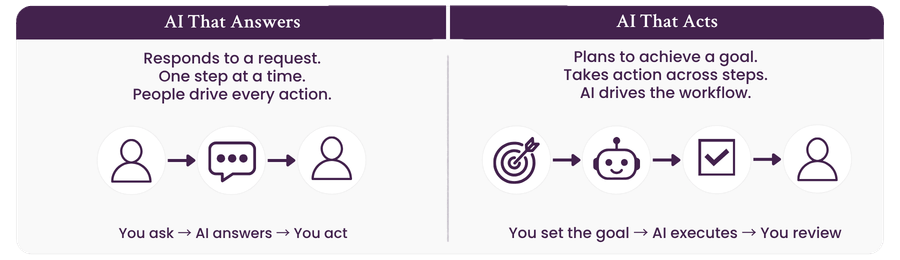
Most enterprise AI still does one thing well: respond. Ask a question, get an answer. Draft something, review it, revise it. A person stays in the loop at every step, because the system has no way to plan past the next output.
Agentic workflows change that. Rather than producing a single response, an AI agent breaks a goal into steps, works out which tools or data sources each step needs, carries them out, checks its own results, and changes course when something doesn't hold up. The difference from earlier automation isn't speed. It's initiative: the system decides what to do next, instead of waiting to be told.
How an Agentic Workflow Actually Runs
Strip away the framework and an agentic workflow follows a repeatable loop. The agent gathers the information it needs — from documents, systems, or a person's request. It weighs that information against the goal and decides what to do. It acts, calling the tools or applications required to move the task forward. Then it checks the outcome and loops back if the result falls short, rather than stopping at the first sign of trouble.
That loop is what separates an agent from a script. A rule-based system executes a fixed path and breaks the moment reality diverges from the plan. An agentic one holds the goal steady and finds another way to get there — pulling a different data source, retrying a step with new inputs, or flagging the case for a person when it genuinely can't resolve it on its own.

Why the Distinction Matters for the Enterprise
Most business processes aren't single tasks. They're chains: pull data from several systems, reconcile it, apply rules, draft an output, and route it for approval. Traditional automation handles the parts of that chain that never change. Generative AI handles the parts that need language or judgment, one request at a time. Neither, on its own, connects the chain end to end.
Agentic workflows close that gap by holding the full sequence in view and carrying context from one step to the next. That's the difference between a tool that helps someone do a task faster and a system you can hand the task to.
Where the Value Actually Shows Up
The clearest returns sit in work that is high-volume, multi-step, and currently held together by people passing information manually between systems or teams: intake and triage, research synthesis, document assembly, exception handling, first-pass analysis ahead of expert review.
The value isn't only speed. It's consistency. A person handling the fortieth case of the day brings less attention to it than the first. An agent applies the same rigor to every case, then routes to a specialist the ones that genuinely need human judgment — which is where that judgment should be spent in the first place.
Autonomy Is a Design Choice, Not a Default
None of this requires a system to run unsupervised. The agentic deployments that hold up in production build in checkpoints, audit trails, and clear lines around what the agent can decide versus what it must hand back to a person. How much autonomy to grant, and where, is a decision an organization makes deliberately — not a setting that comes pre-configured.
The Part That Gets Skipped
Chaining steps together is the easy part. The hard part is domain knowledge: knowing which step actually matters, which exceptions are routine and which are red flags, which output a downstream team will actually use. An agent that can call ten tools but doesn't understand the business logic connecting them will move fast and still land on the wrong answer.
This is why agentic AI works best paired with people who know the domain cold — not as a fallback for when the technology fails, but as the source of the judgment that shapes what the agent does at every step. The technology extends expert capacity. It doesn't replace the expertise behind it.
What to Ask Before You Build
Enterprises evaluating agentic AI tend to get the most value when they start with the process, not the platform:
- Where does work currently stall waiting on a handoff between systems or teams?
- Which decisions are rule-based, and which require domain judgment a person should retain?
- What does "good" look like at each step, and how will you catch it if the agent gets one wrong before it compounds?
- Who reviews the agent's output, and at what point in the sequence?
Answering these before selecting tools keeps a deployment anchored to a business outcome rather than a technology demonstration.
The Shift Worth Paying Attention To
Agentic workflows change what enterprises can expect AI to own — not a faster way to get an answer, but a system that carries a piece of work from start to finish, inside the guardrails an organization sets for it. The enterprises getting real value aren't the ones deploying the most agents. They're the ones pairing the technology with the domain expertise to point it at the right problems, and building in the oversight to trust what it produces.