The New Search Visibility Playbook
The search landscape is undergoing its biggest transformation in decades, challenging many of the assumptions that have traditionally guided how brands are discovered online. As a result, many organizations are losing search visibility – often without realizing it – because conventional SEO metrics still focus heavily on rankings and organic traffic.
Below are some key data points highlighting how dramatically the search environment is changing:
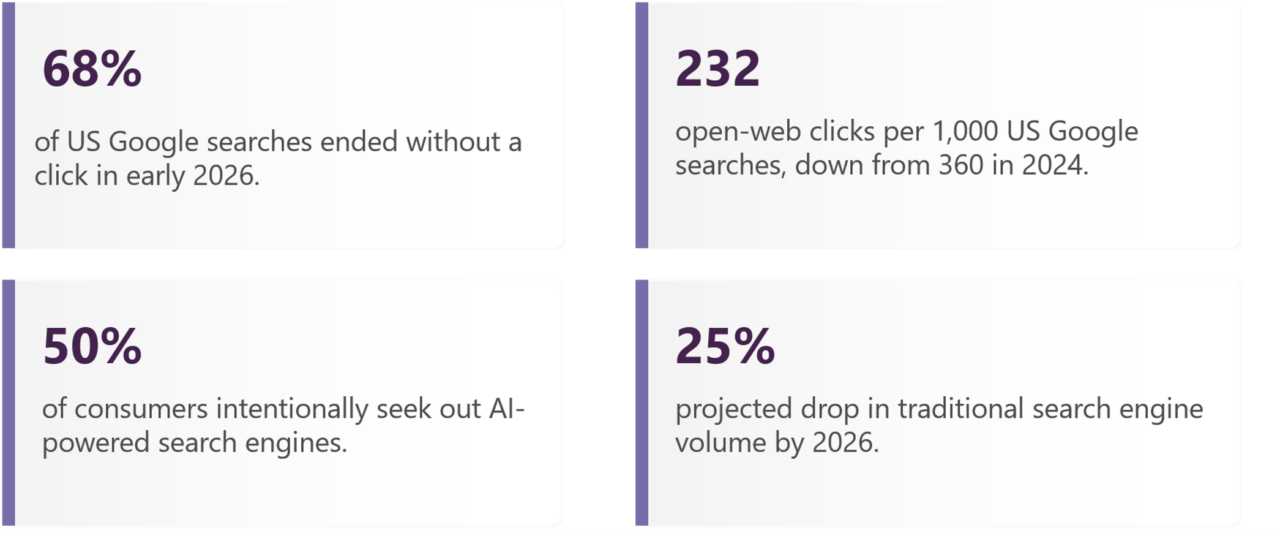
The reason for this is largely structural. AI Overviews now appear in more than 20% of Google searches, reducing click-through rates by nearly 60% when they are present. At the same time, AI-native platforms such as ChatGPT, Perplexity, and Microsoft Copilot are seeing rapid adoption, with nearly half of consumers now actively choosing AI-powered search experiences over traditional search engines.
Search itself has not become less important; it has simply evolved. Increasingly, users are finding answers directly within AI-generated responses rather than through a list of links. As a result, leading brands are shifting their focus from ranking higher in search results to being visible within AI-generated answers.
Zero-click Search Rate Over Time

Note: Historical data has been compiled from multiple sources, including Jumpshot (2016, 2019), Datos/Semrush (2024), and Similarweb (2026). While methodologies differ across providers, the data offers a directional view of the long-term growth of zero-click searches.
What is Actually Happening to Search?
People still have questions – but the way they receive answers is changing.
Today, many users find the information they need without ever visiting a website. Answers are increasingly delivered through AI-generated summaries at the top of search results, conversational platforms such as ChatGPT and Perplexity, and voice- or image-based search experiences that bypass traditional blue links altogether.
This shift is particularly evident for informational searches. Queries that begin with words such as what, how, why, who, or when often have answers that can be summarized within a few sentences in AI Overviews, reducing a user’s need to click through. At the same time, AI-native search platforms continue to gain momentum. Rather than simply listing sources, these platforms generate synthesized and contextual responses, often citing sources directly while bypassing traditional organic search results.
Where Does Search Go Now?

Note: Based on data from Similarweb and SparkToro
Traditional SEO vs. AI SEO: A Different Game Entirely
For years, the objective of SEO was straightforward: rank on page one, earn a click, and drive traffic to a website. While those goals remain important, they are no longer enough on their own.
As AI-powered search becomes a larger part of the discovery journey, a new discipline – often referred to as AI SEO – has emerged alongside traditional optimization practices.
|
Dimension
|
Traditional SEO
|
AI SEO
|
|---|---|---|
|
Core focus
|
Keywords and backlinks
|
Structured, authoritative, conversational content
|
|
Success metric
|
Ranking on search engine results pages
|
Citations in AI-generated answers
|
|
Traffic model
|
Clicks to your website
|
Visibility inside AI summaries
|
|
Optimization target
|
Search algorithms
|
Large language models and natural language processing
|
|
Key question
|
Where do I rank?
|
Am I being cited?
|
Both approaches are now essential. Brands that only track rankings risk overlooking a growing portion of their digital visibility.
What Actually Works in AI Search
AI search is still evolving, and standards vary across platforms. Nevertheless, clear patterns are beginning to emerge around the types of content that consistently gain visibility.
- Build your entity, not just your keywords: AI engines favor entities over keyword strings. If Google recognizes your brand as a distinct, well-defined entity, it is more likely to surface, cite, and recommend it across both search results and AI-generated outputs. Entity-driven content improves AI citation likelihood by more than 35%. Structured data, Wikipedia presence, consistent knowledge panel information, and authoritative third-party mentions all reinforce entity recognition.
- Create content that answers real questions: AI systems pull from content that is fresh, specific, well-structured, and written with demonstrated expertise. The E-E-A-T framework (Experience, Expertise, Authoritativeness, Trustworthiness) is no longer just a Google ranking signal; it is the filter through which AI engines assess credibility. Adding FAQs, key takeaways, and TL; DRs increases the likelihood of inclusion in AI-generated answers because these formats are easy to extract and synthesize.
- Write conversationally and provide context: AI queries are longer and more specific than traditional keyword searches. Users ask full questions, not fragments. Content that mirrors this conversational style, and that adds contextual depth rather than keyword density, will naturally align better with how AI systems retrieve and rank information.
- Take user-generated content seriously: Modern AI engines actively pull from Reddit, Quora, G2, and review platforms because those sources carry firsthand experience and third-party credibility that brand-controlled content cannot replicate. User-generated content accounts for 22% of all AI-generated citations. That is a significant share, and it is a strong argument for engaging with customers in these spaces, responding to reviews, and building a visible community presence.
- Run a citation gap analysis: It is important to identify which pages are being cited by AI engines in your category, especially the ones that mention competitors but not your brand. Then determine what value can be genuinely contributed here and not as a promotional exercise. Gap analysis turns competitive intelligence into a content brief.
- Tailor your approach by platform: ChatGPT, Perplexity, Google AI Overviews, and Microsoft Copilot do not all pull from the same sources or weight signals equally. A one-size-fits-all strategy will underperform. Understanding which platforms your audience uses most, and how those systems work, allows for sharper prioritization.
- Do not ignore SEO fundamentals: AI search engines still crawl the web. Technical foundations like site speed, mobile performance, clean architecture, schema markup, and proper indexing remain prerequisites. A site that AI systems cannot reliably access will not be reliably cited.
The New SEO Funnel

The Metrics That Actually Matter Now
One of the most important changes organizations must make is how they measure visibility. If AI systems increasingly answer questions before users click on a website, then traditional metrics such as click-through rate and organic traffic provide only part of the picture.
New visibility metrics are emerging, including:
- Citation Rate: How often AI systems link to a brand’s URL as a source.
- Generative Share of Voice: A brand’s visibility relative to competitors within AI environments.
- AI Answer Inclusion Rate: The frequency with which a brand’s content appears in AI-generated responses.
These metrics may be more complex to track than rankings, but they provide a much clearer view of real visibility in today’s search environment.
What This Means for Brands
The fundamentals of effective content have not changed. Content still needs to be useful, accurate, relevant, and trustworthy. What has changed is how that content reaches audiences. Even high-quality content can remain invisible if brands fail to establish authority signals that help AI systems discover and recognize it.
The brands more likely to succeed in this environment are treating AI citations as a strategic distribution channel. They are building entity authority, creating content that is easy for AI systems to understand, and continuously monitoring how AI platforms represent their brands.
While the tools and channels may be evolving, the underlying principle remains the same: understand your audience, answer their questions effectively, and make it easy for the right systems to surface your expertise at the right time.
How Evalueserve Approaches This
At Evalueserve, we treat AI search visibility as a measurable business capability that can be systematically improved.
Our Advanced SEO offering combines structured query design, cross-platform testing, and competitive benchmarking across leading AI search environments. Using a query fan-out methodology, we assess brand visibility, analyze citation patterns, and identify opportunities for improvement across multiple AI platforms.
These insights are then translated into actionable content and technical and structural recommendations. The objective is simple: ensure that when AI systems are searching for the most credible and authoritative answer within your category, your brand is positioned to be discovered, trusted, and cited.