
The US retirement landscape is undergoing a significant transformation. Traditional boundaries among retirement savings, employee benefits, and holistic financial wellness are becoming increasingly blurred, creating a new paradigm: integrated workplace solutions.
These solutions combine an employer’s HR, financial, and health benefit programs within a unified framework. This approach enhances employee experience and enables stronger strategic alignment for employers. According to the EY-LIMRA Workforce Benefits 2025 Study, 84% of employers overall and 95% of large employers believe that comprehensive benefits are essential for attracting and retaining top talent. In addition, 57% of small employers and 67% of large organizations plan to expand their benefits offerings in the coming years. This shift represents a clear departure from the siloed, product-centric models of previous decades.
In this article, we examine the key drivers behind this change, recent initiatives by retirement providers to reposition themselves as holistic workplace solution providers, and the implications of this ‘single basket’ model for the retirement industry.
Defining the ‘Single Basket’ Mode
The ‘single basket’ model represents a comprehensive benefits ecosystem managed by a single provider or a consortium that delivers end-to-end services across retirement, health, and wealth dimensions. This approach shifts providers from being product vendors to becoming strategic workplace partners. At its core, the model integrates several traditionally distinct pillars:
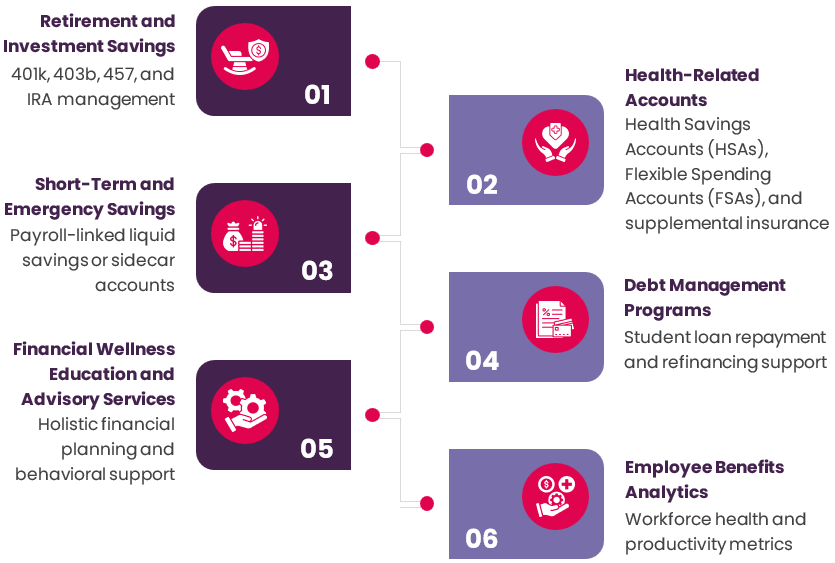
When these elements operate through a unified digital portal, employers and employees perceive them as interconnected components of total financial well-being rather than as separate programs. This approach reflects a broader societal trend toward integration, evident across wealth management, banking, and technology ecosystems.
Key Drivers Propelling This Shift
|
Stakeholder
|
Key Drivers
|
|---|---|
|
Plan Sponsors (Employers)
|
Demand for simpler administration, consolidated reporting, and lower overall costs through partnerships with a single provider.
|
|
Participants (Employees)
|
Rising expectations for intuitive, mobile-first digital platforms that integrate retirement savings, health benefits, and financial wellness in one place.
|
|
Technology
|
Advancements in AI, APIs, and cloud-based recordkeeping enable real-time plan management and personalized engagement at scale for organizations of any size.
|
|
Regulations
|
Regulatory initiatives, such as the SECURE 2.0 Act, and new requirements for lifetime income disclosures are driving integration of in-plan annuities and guaranteed income options within retirement platforms.
|
As the shift towards unified solution providers accelerates, leading firms such as Fidelity, Voya, and ADP are redefining their value propositions by integrating retirement recordkeeping, wealth management, health savings, and financial education into a single, seamless digital ecosystem.
Provider Examples: Integrated Workplace Solutions (2025 Initiatives)

Launched the ‘WealthPath’ platform in October 2025, expanding wealth management capabilities both inside and outside retirement plans. The platform delivers an integrated experience that combines in-plan, retail, and advisory solutions, including financial planning and client relationship management tools.

Introduced the Workplace Retirement Plan Portal in August 2025, a digital platform designed to provide small and mid-sized employers with access to institutional-grade retirement plans. The portal supports a ‘single basket’ approach by offering plan management, education, compliance, and investment selection within one unified environment.

Developed a fully integrated platform that combines payroll, retirement, health, and employee benefits. The 2025 solution offers a single login for HR teams and employees, streamlining plan administration, automated compliance, wellness programs, and mobile engagement.

Continues to deliver a holistic platform that covers retirement, health accounts, and equity compensation, all managed through a central portal.

Continues to deliver a holistic platform that covers retirement, health accounts, and equity compensation, all managed through a central portal.
Implications for the Retirement Industry
As retirement providers adopt integrated workplace solutions, the industry is poised for a fundamental transformation. Key anticipated shifts include:
Retirement Industry Dynamics
New Standard: The rapid deployment of ‘single basket’ workplace solutions marks a significant modernization of the US retirement sector. In 2025, providers have raced to outpace one another by removing barriers, simplifying administration, and improving participant outcomes. With leading fintech firms and established giants driving this innovation, integrated workplace offerings have become an expected standard rather than a future aspiration. According to McKinsey, an integrated benefits ecosystem creates value for both employers and employees.
Reshaped Competitive Landscape: Integrated offerings are fueling large-scale consolidation and creating new battlegrounds for scale and data-driven advantage.
Market Expansion and Inclusion: Integrated models are unlocking access to retirement plans for small and midsize employers who were previously deterred by administrative complexity or cost. Through pooled employer plans (PEPs) and digital-first integration, providers can eliminate traditional barriers and broaden participation.
Retirement Administration and Participant Experience
Operational Efficiency and Cost Reduction: For recordkeepers and third-party administrators (TPAs), integration translates into reduced overhead, faster processing, and improved compliance accuracy. Congruent Solutions reports that automation and integrated systems can lower operational costs by up to 40% while increasing sponsor satisfaction and participant engagement.
Enhanced Data Intelligence and Personalization: By merging payroll, HR, and benefit systems, integrated workplace solutions create continuous data streams that provide deeper insights into workforce behavior. Providers can analyze salary trends, contribution rates, and demographic patterns in real time, thereby enabling predictive analytics for retirement readiness and workforce engagement.
Changing Employer-Provider Relationships: Employers benefit from vendor consolidation, as integrated offerings reduce administrative complexity and deliver unified compliance oversight. ADP’s 2025 analysis highlights that embedded systems, where payroll and retirement are natively interconnected, minimize data replication errors and improve accuracy, ultimately reducing compliance risks and fiduciary exposure.
Participant-centric Ecosystems and Financial Wellness: For participants, integration delivers streamlined, personalized experiences. The convergence of 401(k) plans, HSAs, and short-term savings within unified portals enhances engagement and simplifies financial decision-making.
Conclusion
Integrated workplace offerings are transforming the US retirement industry into a cohesive health-wealth ecosystem. These solutions improve efficiency and compliance, enable data-driven intelligence and personalization, expand access, and position providers as full-spectrum financial wellness partners. Success in this evolving landscape will belong to those who combine technological sophistication with human-centric engagement, delivering not only retirement readiness but continuous financial resilience throughout the entire work-life journey.
How can Evalueserve help?
Evalueserve provides comprehensive market and competitive intelligence solutions to retirement firms, focused on the workplace retirement market, helping them to gain timely access to relevant and actionable insights. Such firms can stay updated with the latest industry trends, regulations, market opportunities, and competitor insights. This would help them to take strategic business decisions such as new investments, potential M&As to enter new markets, expand the existing suite of product offerings, and others.
Here's how Evalueserve can assist clients in these areas:
Industry Research: Evalueserve provides deep industry insights covering the latest trends, evolving regulatory and investment frameworks, market sizing, and potential industry opportunities.
Competitor Strategy: Our competitive insights help develop highly focused competitive strategies to counter imminent threats. We also offer strategic business insights, competitor marketing positioning (participant engagement analysis), and earnings coverage of peers to understand management viewpoints and their strategic plans.
Product Intelligence: Evalueserve conducts product benchmarking, provides insights that enhance the value proposition of any existing suite of offerings, and helps in launching innovative products to stay ahead in the marketplace.
Talk to One of Our Experts
Get in touch today to find out about how Evalueserve can help you improve your processes, making you better, faster and more efficient.


