
In May 2025, The Economist published a sharp and timely analysis—“The Man with a Plan for Vietnam”—highlighting the country’s accelerating economic transformation under Prime Minister Pham Minh Chinh. His reform agenda is ambitious: digital modernization, infrastructure renewal, and a decisive shift toward green energy are all designed to move Vietnam firmly up the global value chain. Vietnam’s trajectory could make it a model for mid-sized economies seeking growth.
At Evalueserve, we see these reforms not just as policy milestones, but as market signals. Vietnam’s savvy, digitally native population and its evolving product landscape are creating fertile ground for innovation, investment, and consumer engagement. Against this backdrop, our report will take a closer look at two industries that exemplify Vietnam’s rising potential. The first is entertainment, where inbound investment is reshaping consumer experiences and redefining competitive dynamics. The second is coffee, a sector that is rapidly moving up high-value end-product value chain rather than raw commodity export. Together, these industries illustrate Vietnam’s dual trajectory—emerging as a magnet for foreign investment while simultaneously cultivating homegrown champions with international reach.
Vietnam’s Mass Entertainment Boom: Where Gen Z Leads and Banks Follow
Since 2020, the country has quietly transformed into Southeast Asia’s most vibrant playground for Gen Z-driven content. It’s a full-blown ecosystem where digital-native audiences, OTT platforms, and financial institutions are rewriting the rules of brand building and monetization.
Vietnam’s entertainment producers have recalibrated their content strategies to align with Gen Z’s demand for personalization, interactivity, and digital-first experiences. Platforms now prioritize viral formats, lifestyle-driven narratives, and personality-centric programming. Distribution is anchored in OTT applications and social media ecosystems, enabling real-time engagement and multi-platform amplification.
The Few Who Rule the Screen
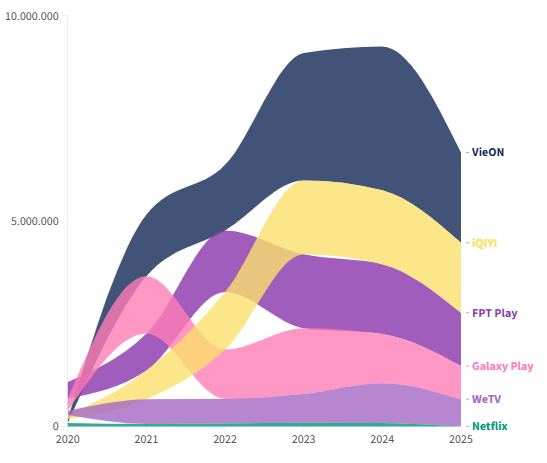
The competitive landscape remains concentrated, with a few key players capturing disproportionate market share, especially in content production and streaming. VieON, backed by DatVietVAC and BCG Digital Ventures, has become Vietnam’s leading OTT platform. With 72 million registered devices and 5 million monthly active viewers, it has outpaced Netflix and iQIYI. Its VieON Originals—including Rap Viet, Running Man Vietnam, Who Is the Single, and Brothers Say Hi—are now synonymous with viral, high-quality local content.
Another notable player is Yeah1 Group who have shown positive signs of rebound in recent years after the incident of YouTube terminating Adsense agreements with its subsidiaries. By restructuring and pivoting to localized Chinese formats, the company doubled YoY revenue and regained market presence. Sisters Who Make Waves drew 700 million viewers across platforms and 7 billion hashtag views, fueling sponsorship and merchandising. Call Me By Fire generated $13 million in sponsorship and broadcast revenue, followed by 5 concerts with 50,000 attendees each. By blending Vietnamese cultural elements with modern beats and reviving 1990s–2000s music, Yeah1 attracted fans across generations, tapping into nostalgia, national pride and viral trends approved by Chinese viewership.
The Entry of Non-conventional Stakeholders
Despite strong consumer demand and early commercial success, Vietnam’s entertainment production ecosystem remains fragmented and undercapitalized, inhibiting the overall industry transparency and sustainability. Aside from Yeah1, publicly listed entities are virtually non-existent across adjacent verticals such as cinema, music, gaming, and animation. It is quite paradoxical as the market’s supply base is readily available with a massive base of thousands of independent studios and creative content creators.
However, in recent years, the market witnessed a shift in fundraising with the entry of non-traditional stakeholders, particularly financial institutions seeking brand differentiation and customer acquisition. Techcombank, as co-organizer of Call Me By Fire, tied concert ticket giveaways to product activation, offering encore tickets to customers who opened accounts with the Automatic-earning feature. Following the first concert, 4,500 tickets were distributed and 120,000 customers enabled Automatic Interest on the mobile app, driving a 0.2–0.5% increase in low-cost non-term deposit.
Similarly, VPBank leveraged its title sponsorship of VPBank K-Star Spark, featuring international artists such as G-Dragon, to drive product uptake. The initiative led to a 45% increase in new credit card issuance, a 51% rise in card spending, and VND 4,000 billion ($150 million) in incremental deposits.
These outcomes underscore the sector’s ability to deliver measurable ROI through gamified engagement and affinity-based marketing in a fast-growing market where consumers are more willing to spend on intrinsic values.
The remarkable success of non-traditional investors also illustrates that Vietnam’s entertainment market offers significant opportunities for unconventional entrants to pursue diverse, untapped roles.
Foreign investment is in, yet none realizes the aspirations
Vietnamese audiences exhibit strong affinity for East Asian content, shaped by decades of cultural exposure. Chinese historical dramas and Korean pop culture continue to resonate across age groups, especially among Gen X (Boomers) and Gen Y (Millennials) who now are placed in mid-to-high income group, signature by growing awareness of mental health and self-indulgency. Platforms such as TikTok and Facebook amplify these trends by curating East Asia-centric content in formats ranging from livestreams to short-form variety shows.
While Chinese OTT platforms (e.g., WeTV, iQIYI) have gained traction in Vietnam market, their limited localization strategies present an opportunity for other investors to differentiate through culturally embedded storytelling and national identity.
Korean agencies have also begun participating in Vietnam's entertainment industry to capitalize on the Hallyu wave. However, their engagement has largely been confined to limited roles in marketing, event facilitation, or serving as auxiliary partners for K-Pop-related activities—making it challenging to achieve scalable growth in the market.
Global players like Netflix and Amazon Prime face pricing barriers and regulatory constraints, with Decree No. 71 (2023) forcing streaming platforms to choose between cinema or reality content. This led Amazon Prime to exit, citing a mismatched model, while Netflix removed reality shows from its Vietnamese offerings.
Piracy via illegal foreign-hosted websites further undermines paid platforms, as consumers remain accustomed to free, immediate access. In response, the Ministry of Culture, Sports and Tourism is drafting a long-term Entertainment Industry Development Master Plan to 2045, aiming to strengthen legal frameworks, incentivize investment, and enhance IP protection across music, cinema, e-sports, fashion, and festivals.
Although foreign players have historically struggled to secure market share, the growing involvement of non-traditional stakeholders signals that Vietnam’s entertainment sector is entering a new phase—one that warrants renewed consideration from global investors.
Strategic Implications
Vietnam’s mass entertainment sector represents a high-growth, consumer-centric opportunity for investors, brands, and content creators. Its convergence with financial services, digital platforms, and cultural capital positions it as a strategic lever for market expansion, brand building, and long-term value creation.
Foreign investors eyeing Vietnam’s entertainment sector can learn from the success of non-traditional entrants like Techcombank and VPBank, who have turned concerts, festivals, and lifestyle events into powerful customer engagement engines. The most promising models are the following:
- Ecosystem partnerships with banks, telcos, or fintechs to integrate entertainment into loyalty and payment platforms.
- Digital-first plays in gaming and streaming tailored to Vietnam’s young, mobile-savvy population.
- Experiential sponsorships that tie financial products to premium event access.
- Co-investment in local content and IP with global distribution potential.
Hybrid approaches that blend finance and entertainment—such as event-linked credit cards or cross-sector loyalty ecosystems—offer differentiated value but require strong local execution. Ultimately, success lies in embedding entertainment within broader lifestyle ecosystems rather than pursuing standalone ventures, ensuring both native cultural resonance and sustainable growth.
Businesses seeking to engage Vietnamese consumers—particularly Gen Z—must consider integrated approaches that combine content, commerce, and community. The next wave of growth will favor those who co-create, not just sponsor.
Vietnam’s Coffee Industry: The Next Big Play for Value Creation
While Vietnam’s entertainment sector is notable with its Gen Z-driven momentum, another industry is quietly brewing a transformation of equal—if not greater—strategic significance: coffee. Long known as a commodity exporter, Vietnam is now pivoting toward premium, value-added products, unlocking a pivotal opportunity for investors to drive premiumization and long-term value creation in Vietnam’s consumer market.
Vietnam is no longer just the world’s low-cost green bean supplier—it’s evolving into a high-margin processing powerhouse for instant, roasted, ready-to-drink (RTD), and specialty coffee. This shift is still in its infancy, which means early investors have a rare window to capture outsized returns.
From Commodity to Premium: The Deep-Processing Investment
For decades, 90% of Vietnam’s coffee exports were raw beans, leaving the lion’s share of profits to foreign brands. That era is ending. Global and local leaders are pouring capital into advanced processing facilities, unlocking premium pricing and brand leverage.
By 9M2025, value-added coffee—roasted, instant, and specialty—accounted for only 12–15% of Vietnam’s exports but fetched $6,000 per ton versus the average $5,655, with specialty lots reaching up to 2x the global average. Among the top 10 buyers, Asian markets emerged as premium importers: Thailand led at $7,995 per ton and Japan at $6,276, while European buyers such as Spain, Germany, and Italy paid below-average prices (under $5,655). This contrast underscores Asia’s rising influence in boosting Vietnam’s high-value export of deep-processed coffee products.

As demand for specialty brews and ready-to-drink formats surges in neighboring markets like Japan, China, South Korea, and Thailand, Vietnam is uniquely positioned to become the region’s primary deep-processing hub. However, capturing this 'value-added' segment requires a level of technical sophistication and capital investment that currently exceeds the reach of most domestic players. This creates a unique strategic opening where global expertise and foreign capital can bridge the gap between Vietnam’s raw supply potential and the region’s demand for ready-to-use products.
FDI Dominates - But the Field Is Still Wide Open for Global Coffee Houses
In Vietnam‘s deep-processing coffee segment, foreign players are currently at the center of the stage. 8 of the top 10 exporters in 2024 were global giants like Nestlé, Olam, and Marubeni, while Trung Nguyen was the only notable domestic manufacturer which made it to the list. Local competition remains thin, constrained by high capital requirements and the challenges of building globally recognized brands. As Nguyen Nam Hai, Chairman of the Vietnam Coffee Cocoa Association (VICOFA), notes, only large-scale operators can afford the significant CAPEX needed for advanced facilities, such as high capacity spray drying plants. Moreover, establishing a globally competitive brand is a long game: Trung Nguyen’s journey to international recognition took more than 25 years.
These structural barriers - high capital intensity and the long runway for brand building - create a clear whitespace for foreign investors. Global players with scale, technology, and branding expertise are uniquely positioned to accelerate Vietnam’s shift toward premium coffee. This opens up several possible strategic entry points:
- Building or partnering with local leaders in processing plants for soluble coffee, extracts, and RTD.
- Co-branding and private-label strategies leveraging Vietnam’s origin story.
- Positioning premium robusta-based products for domestic and global markets.
Nestlé’s model, for example, sets the benchmark for scalable success: producing its own brands while acting as OEM for Starbucks and Blue Bottle. This dual approach maximizes capacity and brand reach. By producing for both its own brands and third-party labels, Nestlé maximizes utilization of high-capacity processing facilities, ensuring economies of scale and faster ROI on capital-intensive assets. Acting as an OEM for globally recognized coffee houses accelerates Nestlé’s penetration into premium segments and international markets without the long lead time and marketing efforts required to build a new brand equity from scratch.
Dual Tailwinds for Cross-border Investments: Robust Demand Meets Stable Supply
For global players eyeing Vietnam’s coffee processing segment, the timing couldn’t be better. The market offers a rare combination of strong demand and reliable supply - two tailwinds that create a compelling case for entry.
On the demand side, Vietnam’s domestic coffee market is projected to exceed $1 billion by 2030, fueled by a young, urban middle class. Export values are on track to hit $8 billion in 2025, supported by trade agreements and pro-investment policies. The EU–Vietnam Free Trade Agreement (EVFTA) eliminates tariffs of 9–12% on processed coffee, significantly improving competitiveness in Europe’s high-value markets. Similarly, the Comprehensive and Progressive Agreement for Trans-Pacific Partnership (CPTPP) grants duty-free access for 97–100% of Vietnamese goods in member countries such as Japan, Singapore, and Malaysia, opening premium Asian markets to deep-processed coffee exports. Domestically, Investment Law No. 134/VBHN-VPQH (2025) provides tax breaks, tariff exemptions, and land rent reductions for high-tech coffee projects, incentivizing capital inflows and modernization of processing facilities. Together, these measures enhance Vietnam’s ability to move up the value chain, expand export revenues, and establish itself as a global hub for specialty and processed coffee.
On the supply side, Vietnam offers an abundant source for robusta and is scaling specialty coffee to 19,000 hectares by 2030. USDA projects a 7% increase in green beans output for 2025–2026, with 80% earmarked for export. Compliance with EU sustainability standards (EUDR) is underway, with government-backed monitoring systems that covers 136,000 hectares of coffee plating area to enhance traceability and compliance with global standards.
Vietnam’s coffee sector is at a tipping point - poised for premiumization and global scale. Although the supply chain remains highly fragmented, with the majority of coffee crops cultivated by small household farmers, and sustainability compliance adds complexity, these aren’t obstacles. They’re strategic barriers that keep competition thin and reward early movers. Foreign investors with financial strength to build modern processing facilities, consolidate supply chains, and amplify global brand reach will own the next wave of growth.
Outlook for next chapter of growth
Vietnam’s entertainment and coffee industries present rare opportunities for investors seeking to pioneer and secure early market share with a resilient, long-term strategy. Both sectors remain significantly under-exploited, offering vast potential yet to be fully realized. Success will hinge on adopting business models that prioritize partnership and collaboration with local players, leveraging Vietnam’s increasingly favorable regulatory environment. For those prepared to act decisively, the stage is set for transformative growth and substantial returns.
Talk to One of Our Experts
Get in touch today to find out about how Evalueserve can help you improve your processes, making you better, faster and more efficient.


