FY’25 highlights
Deal values rebound despite lower volumes
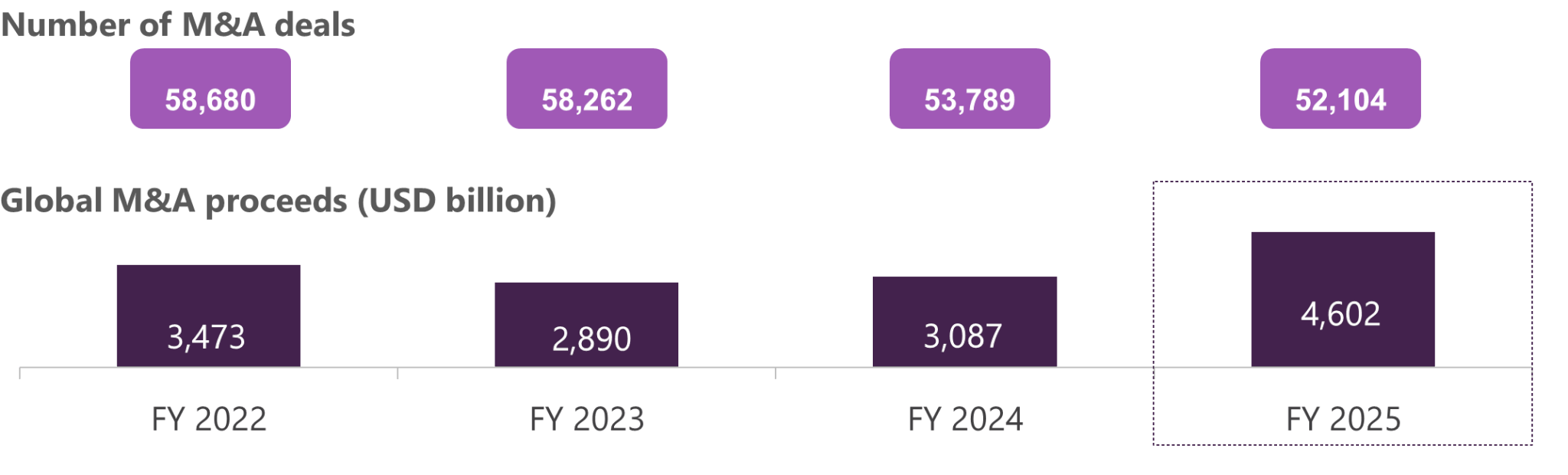
During FY’25, the number of announced M&A deals fell 3% YoY to 52,104 globally, from 53,789 in FY’24. Despite the decline in volumes, aggregate deal value rose 49% to USD 4.6 trillion, the strongest level of dealmaking since 2021. Regionally, M&A activities increased in the US and Europe by 57% and 23% YoY, respectively, with the US accounting for 50% of the total deal volume, the highest since 1998. Similarly, APAC M&A activity rose 47% YoY, making FY’25 the region’s strongest year in four years. Geopolitical tensions, trade frictions and regulatory uncertainty continued to weigh on global sentiment. Despite these challenges, the technology and industrials sectors led the market, accounting for 18% and 15% of total global deal value, respectively.
Global debt capital market (DCM) hits record high in 2025
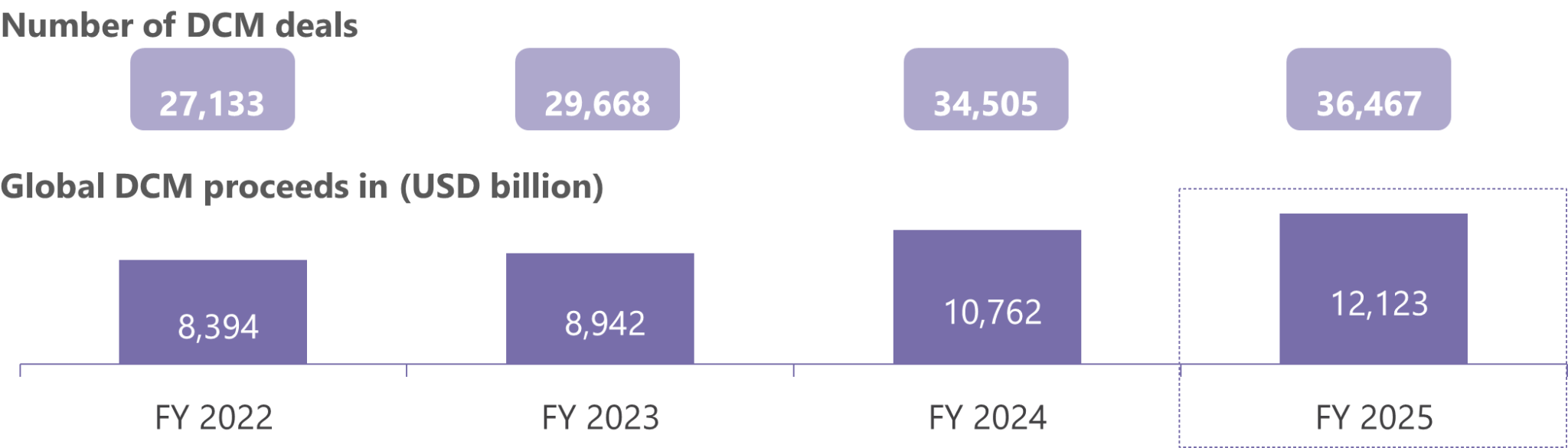
Global DCM activity remained strong in FY’25, reaching USD12.1 trillion, up 13% compared with FY’24, representing the market’s strongest performance in over four decades. The number of new offerings introduced during FY’25 rose by 6% YoY to an all-time high of just under 36,500. Investment-grade corporate debt issuance grew by 13% during FY’25, compared with FY’24. It marks the strongest full year period for global high-grade corporate debt. Similarly, high-yield debt issuance rose by 24% YoY to a fouryear high. Green bond issuance totaled USD497 billion, reflecting a 5% surge compared with FY’24. However, green bond activity decreased by 7% on a QoQ basis, compared with Q3’25. Across sectors, technology, consumer staples and telecom posted double‑digit growth in DCM activity compared with FY’24.
ECM activity accelerates as IPO and convertible surge
During FY’25, global equity capital market (ECM) activity rose to USD738 billion, up 15% YoY. This increased ECM activity marks the strongest annual performance for global ECM activity in four years. The US accounted for 35% of total issuances, with proceeds rising 3%, compared with FY’24. Similarly, ECM activity in China doubled YoY, reaching its highest full year share of global ECM activity in the past two years. Global initial public offerings (IPOs), excluding special purpose acquisition companies (SPACs), totaled USD146 billion, up 29% YoY, marking the most active IPO environment since 2022. IPO proceeds on US exchanges rose by 44% YoY, hitting a four-year high. Convertible offerings reached USD162 billion, up 40% YoY, and accounted for 22% of total ECM deals. The technology, financials, energy and power sectors were the most active, collectively accounting for 60% of all convertible issuances in FY’25.

Top five M&A deals (FY’25)
|
Date of announcement
|
Acquirer’s Name
|
Acquirer’s Location
|
Target
|
Target’s Location
|
Value (USD billion)
|
Target’s Industry
|
Deal type
|
|---|---|---|---|---|---|---|---|
|
Jul 29, 2025
|
Union Pacific
|
US
|
Norfolk Southern
|
US
|
71.5
|
Industrials
|
Cash & stock
|
|
Sep 29, 2025
|
PIF, Silver Lake & Affinity Partners
|
US
|
Electronic Arts
|
US
|
49.4
|
Tech
|
Cash
|
|
Jun 3, 2025
|
Toyota Fudosan
|
Japan
|
Toyota Industries
|
Japan
|
25.9
|
Industrials
|
Cash
|
|
Mar 18, 2025
|
Alphabet
|
US
|
Wiz
|
US
|
32.0
|
Tech
|
Cash
|
|
Jan 10, 2025
|
Constellation Energy
|
US
|
Calpine
|
US
|
26.9
|
E&P
|
Cash
|
Investment banking revenues rebound as market conditions improved
In FY’25, investment banking revenues across major banks rebounded, driven by improved global market conditions and a lower base. The resurgence of mega deals, increased boardroom confidence supported by strong corporate earnings, expectations of potential interest rate cuts later this year, and buoyant capital markets were key drivers of this recovery. Looking ahead, market performance is expected to strengthen in 2026-2027, supported by pent-up M&A demand and a robust deal pipeline, provided macroeconomic conditions remain stable in the backdrop of geopolitical and tariff uncertainty.

Note: Revenues for Deutsche and Barclays were converted into USD using the exchange rate as of December 31, 2025
Revenue for Deutsche Bank reflects revenue from Investment Banking & Capital Markets
Bulge bracket investment banks – FY’25 highlights


JP Morgan’s investment banking fees increased by 7% YoY in FY’25, driven by higher fees across all products, with strength in M&A advisory. The bank’s pipeline remains robust, and the outlook, along with the market backdrop and client sentiment, continues to be upbeat. The bank remains in #1 position for global investment banking fees with 8.4% wallet share for the year.


Goldman Sachs’ investment banking fees increased by 21% YoY in FY’25, primarily due to significantly higher net revenues in advisory. Advisory net revenues were up by 34% YoY in FY’25, driven by a significant increase in completed M&A volumes. Equity underwriting increased by 6% YoY in FY’25, supported by IPOs and convertible offerings, and debt underwriting increased by 12% YoY in FY’25, reflecting an increase in asset- backed and investment-grade activity. The firm’s investment banking fees backlog was significantly higher compared with the end of 2024, primarily driven by advisory fees. The bank remains stable, and management expressed optimism about accelerated deal activity.


In FY’25, Morgan Stanley’s investment banking revenues up by 23% YoY, reflecting secular strength across M&A advisory, equity underwriting and debt underwriting. Advisory revenues were up by 21% YoY, driven by higher completed M&A transactions across all regions. Equity underwriting revenues increased by 23% YoY, on higher IPOs and convertible offerings in a constructive market environment. Fixed income underwriting revenues increased by 26% YoY, driven by higher issuance volumes, benefiting from increased event-related activity. The bank’s pipeline remains healthy, global and diversified across sectors.


Bank of America’s America’s investment banking fees increased by 7% YoY in FY’25, with strong growth in advisory and debt underwriting. Advisory was up 12%, debt underwriting increased 12%, and equity underwriting decreased 7% YoY respectively in FY’25. The bank’s activity pipeline remains strong amidst a more constructive market environment and maintained #3 investment banking fee position globally.

Citi’s investment banking fees increased by 20% YoY in FY’25, reflecting secular growth in advisory, equity and debt capital markets. Advisory fees increased 53% YoY, driven by momentum across several sectors and continued share gains with financial sponsors. ECM fees up by 2% YoY in FY’25, and DCM fees increased by 5% YoY, led by leveraged finance issuances. The bank participated in 15 out of the 25 largest investment banking transactions of the year, driving a YoY 30bps increase in wallet share.


Deutsche Bank’s revenue from investment banking & capital market (IBCM) business decreased by 7% YoY in FY’25, led by a 14% YoY decrease in debt origination revenues. This more than offset growth in equity origination, which rose 21% YoY, and a 1% YoY rise in advisory revenues. The improved performance in FY’25 is expected to continue in FY’26 as advisory business seeks to build on the development seen in the business over the last eighteen months, and a strong pipeline for upcoming year. Equity origination business is expected to continue providing a competitive offering across products, with a specific focus on IPOs.
M&A advisory firms – FY’25 highlights
Similar to investment banks, the revenue of major advisory firms rebounded in 9M’25. While most firms recognize the heightened risks from ongoing geopolitical tensions, economic uncertainty, inflationary pressures, and volatile market conditions, they remain optimistic. Looking ahead to the rest of 2025, these firms expect better access to debt capital and an increase in deal-making activity. However, uncertainty surrounding tariffs remains a key risk.

Note: Houlihan Lokey’s fiscal year ends in March (represents numbers for the nine months ending Decembers 25).
M&A advisory firms – FY’25 highlights


Lazard’s financial advisory revenue increased by 5% YoY in FY’25, primarily attributable to an increase in the average fee for completed transactions as compared to the prior year. The firm participated in several marquee transactions during FY’25, reflecting collaboration across banking teams and the strength of the global franchise. The management sees an increasingly constructive environment for advisory activity. Outlook for financial advisory, the M&A cycle continues to deepen while client demand remains strong for other advisory solutions such as private capital advisory and restructuring and liability management.


Houlihan Lokey’s revenues increased by 15% YoY in 9M’25, primarily due to a rise in the number of fee events, driven by improvements in M&A activity and higher average transaction fee. The firm’s financial and valuation advisory business is gaining momentum in line with the market recovery. Also, it performed well in the last 3 quarters of the year despite market uncertainties and entered the last quarter of the year with a better macro environment than it had in the last 9 months. If conditions remain on the current trajectory, it is well positioned to continue to experience year-over-year.

PJT’s advisory revenue rose 14% YoY in FY’25, primarily due to growth in strategic advisory revenue. The company’s full-year outlook remains largely unchanged, with expectations for a significant increase in strategic advisory revenue in FY’26. PJT Partners anticipates strong growth in its strategic advisory division, with projections to surpass 2025 levels. Future guidance indicates a gradual improvement in M&A activity, supported by easing economic and regulatory uncertainties.
The road ahead
AI as a structural force is reshaping M&A
AI is rapidly driving strategic shifts across industries, accelerating decisions around scale, capabilities, data access and talent, while fundamentally influencing both deal strategy and execution. Capital is flowing heavily into AI‑related infrastructure such as data centers, power generation and energy networks, alongside investments in technology development and customization. In the near term, the sheer magnitude of this multi‑trillion‑dollar investment cycle may absorb capital that might otherwise be deployed toward acquisitions, temporarily moderating M&A activity. Also, AI is accelerating convergence across sectors, eroding traditional industry boundaries - for instance, technology firms are moving directly into energy and power assets, while industrial and healthcare players are acquiring data, analytics and software capabilities to embed AI throughout operations and research and development.
Regulatory and policy uncertainty adds friction to large‑scale M&A
Shifts in regulation and public policy continue to inject uncertainty into the deal environment. Ongoing antitrust enforcement poses particular challenges for large-scale transactions, making regulatory approvals more complex and outcomes and timelines harder to predict. At the same time, evolving legal and regulatory requirements spanning data protection, cybersecurity and environmental, social and governance considerations are intensifying scrutiny across the M&A lifecycle. These developments are materially influencing how transactions are structured, assessed and executed. In parallel, increasing use of foreign investment controls, national security reviews and sanctions regimes is adding further complexity, often slowing deal processes and increasing execution risk.
Megadeals are driving a top‑down recovery in global M&A
Global deal values surged in 2025, largely fueled by a revival in megadeals, even as transaction volumes across the wider market showed limited growth. This widening gap between value and volume highlights the development of a K‑shaped M&A environment, where well‑capitalized buyers are executing large, strategic transactions while much of the market continues to be held back by valuation mismatches, execution complexity and residual uncertainty. The current upswing therefore reflects a top‑down recovery led by large‑scale deals rather than a broad‑based increase in activity. Looking into 2026, the return of megadeals is restoring confidence across global M&A markets and signaling a renewed willingness to transact, with momentum expected to spread as valuation gaps narrow, capital re‑enters the market and financing conditions become more supportive.
IPO market recovery reinforces deal confidence
IPO markets are beginning to reopen, providing an early boost to confidence across the deal environment and favoring companies aligned with long‑term growth themes such as AI infrastructure. Although public listings remain a viable exit option for only a limited subset of businesses, stronger equity markets improve price discovery and investor risk appetite, reinforcing the conditions needed for a more durable M&A recovery. Over time, healthier public markets should also help private equity firms make progress in exiting an estimated 32,500 portfolio companies, many of which have been held beyond their original investment timeframes.
Private markets emerge as the primary engine of M&A activity
In 2026, private capital has become a core driver of global M&A, reflecting the exceptional scale of resources controlled by private equity and other private market investors, alongside their dual imperative to deploy capital and exit seasoned investments. Elevated levels of dry powder and extended holding periods are pushing sponsors toward larger and more intricate transactions, including sponsor‑to‑sponsor sales and complex take‑private structures. As a result, deal execution is evolving, with greater reliance on tailored financing arrangements and innovative capital solutions to overcome valuation mismatches and enable transformational deals. This has firmly positioned private markets as a leading source of deal flow, structural complexity and innovation in the current M&A cycle.
Shareholder activism emerges as a direct force shaping M&A decisions
Public shareholder activism is gaining momentum in 2026, with campaigns becoming more numerous and assertive, and activity nearing levels not seen in five years as market conditions increasingly support intervention. Activists are placing greater emphasis on transaction‑led outcomes, advocating for breakups, asset sales, full sale processes or transformative acquisitions as a means to unlock value and sharpen corporate strategy. More stable valuations, abundant capital across public and private markets and greater confidence in deal execution have enhanced activists’ credibility and influence, elevating activism from a peripheral governance consideration to a more direct and powerful force shaping corporate M&A decision‑making.
Geopolitical risk drives strategic M&A and supply‑chain reconfiguration
Geopolitical uncertainty and trade frictions remain an important consideration for dealmakers, particularly in sectors exposed to global supply chains. Continuing conflict in Ukraine, the unsettled Middle East, trade tensions, tariffs and most recently, US actions in Venezuela are affecting not only political sentiment but also global trade and commodity markets. At the same time, rising defense and security budgets across the US, Europe and parts of Asia are reshaping capital allocation priorities, with implications for industrial supply chains, technology investment and M&A activity in defense-adjacent sectors. More broadly, geopolitics is increasingly acting as a catalyst for strategic M&A as companies reassess supply chains to improve resilience, reduce dependency risks and support localization or nearshoring strategies. These shifts are driving transactions focused on regional manufacturing, logistics, infrastructure and critical inputs as businesses prioritize supply security alongside cost and efficiency.
Talk to One of Our Experts
Get in touch today to find out about how Evalueserve can help you improve your processes, making you better, faster and more efficient.