
“Even the smallest person can change the course of the future.”
This timeless line from J.R.R. Tolkien resonates powerfully as Timor-Leste, ASEAN’s smallest nation, steps onto the regional stage as its newest member. Late 2025 saw a remarkable upturn in economic forecasts across Southeast Asian markets, fueled by export expansion and diminished tariff risks—ushering in new hope for emerging economies. The conclusion of the 47th ASEAN Summit not only celebrated these developments but also marked a historic moment: the official induction of Timor-Leste, whose determination and potential promise to redefine the possibilities for smaller nations within ASEAN.
Historic ASEAN Accession: A Dream Realized
This pivotal accession represents the culmination of Timor-Leste’s persistent two-decade-long pursuit to join the bloc, offering the nation unprecedented opportunities to shape its future among regional peers. With its membership, Timor-Leste now gains access to a regional market of over 680 million people and a $3.8 trillion economy, embedding itself within a dynamic alliance of 11 nations. This expanded partnership opens doors for Timor-Leste’s 1.5 million citizens and $2 billion GDP to benefit from ASEAN investment initiatives such as the Initiative for ASEAN Integration (IAI), the Regional Comprehensive Economic Partnership (RCEP), and the ASEAN Free Trade Area (AFTA).
Additionally, ASEAN membership strengthens Timor-Leste’s access to global markets and enhances its integration into regional supply chains, including eligibility to participate in the ASEAN Trade in Goods Agreement (ATIGA), which removes tariffs on nearly all intra-ASEAN products. While ASEAN integration may present unfamiliar challenges, adapting to change brings new perspectives and opportunities, positioning the economy for more sustainable and attainable growth.
Addressing the Oil Dependency Dilemma
Although Timor-Leste has made notable strides since gaining independence in 2002, it continues to grapple with significant development challenges that threaten its long-term prosperity. The nation’s economy remains heavily reliant on oil and gas, with more than 95% of export earnings stemming from this sector. At the heart of this reliance is the Petroleum Fund—a sovereign wealth fund established to manage oil revenues, support fiscal stability, and finance government operations and projects. In recent years, the Fund’s value has experienced considerable volatility due to fluctuations in investment performance, fair value adjustments, and substantial government withdrawals. These financial swings have coincided with a gradual shift away from petroleum revenue toward alternative investment inflows for the Fund.
By November 2025, the Petroleum Fund’s assets were valued at approximately US$18.91 billion. However, the Fund now faces mounting pressure following the depletion of key oil fields, especially after the permanent shutdown of the Bayu-Undan field, Timor-Leste’s largest source of petroleum income, in June 2025. With petroleum revenue streams drying up, the government has prioritized economic diversification as a critical path forward to secure sustainable growth and fiscal stability. Efforts are underway to develop new sectors—including agriculture, tourism, and renewable energy—to broaden the economic base and reduce dependence on oil and gas.
Driving Sectoral Dynamism
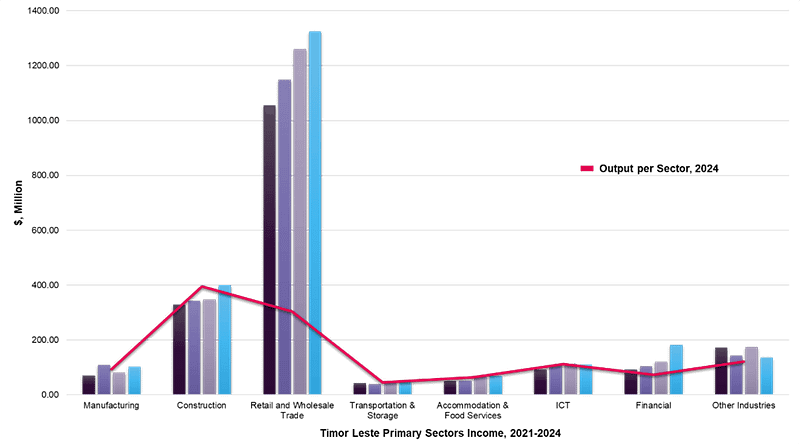
This illustration provides the distribution of Timor-Leste’s primary sector income and output, providing a snapshot of how the non-oil economy is structured. Retail and wholesale trade dominate, serving as the core income source between 2021 and 2024. In 2024, construction and financial services gained notable momentum, fueled by continuous public investments and greater access to credit. These trends highlight trade and government-linked activities as the central drivers of economic activity, underscoring the need for broader sectoral diversification to reduce reliance on a few key industries.
Sectoral insights reveal that agriculture remains Timor-Leste’s foremost non-oil export sector, generating $20 million in 2024 and representing 14% of total exports—primarily through coffee, which is a staple commodity for the country. Wholesale and retail trade account for 54% of all businesses, producing $1.3 billion in inter-sectoral income and providing more than half of national revenue. Alongside these, Construction, Financial Services, and Real Estate continue to deliver steady gains, supported by expanding credit, digital financial inclusion, and urbanization in Dili. Despite this progress, the manufacturing sector remains underdeveloped, contributing only 8% to total output and maintaining a strong dependency on imports for basic goods.
This sectoral breakdown not only underscores the areas where Timor-Leste’s economy is robust but also brings into focus its underlying vulnerabilities, emphasizing the urgent need for ongoing diversification and carefully targeted investments in emerging industries. Building on the existing foundation, critical growth opportunities lie in agriculture, tourism, and energy.
- Agriculture and Coffee: In 2025, good weather led to a 72% jump in coffee output to 8,200 tons. Projects like ADB’s CALIP aim to double production and boost exports by 270% by 2030, but the sector still faces low productivity, limited financing, and infrastructure gaps, which keep import dependency and food insecurity high. By developing a full coffee ready-to-drink value chain—including processing, packaging, branding, and distribution—Timor-Leste could capture greater value domestically and create new jobs in manufacturing and retail. Targeted investments in modern processing facilities, quality control, and export logistics would help position Timor-Leste’s coffee as a premium product, increasing revenues and reducing reliance on raw exports.
- Tourism shows potential for economic growth, with 59% of businesses planning to hire more staff. However, barriers include limited financing, skill shortages, weak infrastructure, and seasonal income. In recent years, the Timor-Leste government has allocated approximately $15 million annually to tourism infrastructure projects, focusing on improving transportation links, developing hospitality facilities, and enhancing visitor experiences. Continuous government-private sector talks and the ASEAN accession signal improved regulations and attract more visitors, but targeted investment is still needed in transport, digital networks, training, and branding.
- Energy and the Greater Sunrise and Tasi Mane Projects: Energy remains Timor-Leste’s strongest prospect for future revenue, particularly through the Greater Sunrise offshore gas project and the Tasi Mane initiative. If fully developed, these efforts could yield up to $52 billion by 2056, with significant local benefits if gas is processed domestically. Construction is projected for 2027–2028, and production could begin by 2032. The government is also pushing for a national gas pipeline from Greater Sunrise to the southern coast, aiming to build a local LNG and petrochemical industry and further diversify the economy. Meanwhile, Timor-Leste is accelerating investments in renewable sources—solar, hydropower, and wind—to lessen dependence on imported fuels and foster sustainable development.
Regulatory Developments and Economic Implications
Timor-Leste is advancing a pro-business climate through significant regulatory reforms aimed at expanding economic opportunities and fortifying fiscal resilience. The forthcoming Export Promotion Law is set to broaden the trading landscape, encouraging local enterprises to access new markets and invigorating export-led growth. The scheduled introduction of a Value Added Tax (VAT) in 2027 will diversify domestic revenue streams and help stabilize public finances, especially as oil income wanes. In tandem, the government is strengthening its investment framework, enhancing digital networks, and prioritizing transparent governance to attract foreign direct investment. These measures collectively mark a shift toward a more resilient and diversified economy, requiring ongoing policy refinement and effective stakeholder engagement to ensure new regulations benefit both businesses and the broader population.
Key Insights and Outlook
Timor-Leste’s accession to ASEAN represents a pivotal turning point for the nation, opening the door to greater market access, deeper regional integration, and enhanced policy credibility. This milestone is not only a diplomatic achievement but also a strategic platform for economic collaboration with neighboring countries, signaling a commitment to shared prosperity and development.
Timor-Leste stands at a crossroads: with petroleum revenues in decline, the country must accelerate its efforts to diversify the economy. The path forward hinges on translating regional integration into tangible progress, expanding agriculture beyond raw coffee exports, scaling up tourism and hospitality, and unlocking the transformative potential of energy projects.
Sustained reform, strategic investment, and ongoing stakeholder engagement are essential to foster inclusive growth and strengthen resilience. By leveraging new regulatory frameworks, modernizing key sectors, and embracing innovation, Timor-Leste can build a more robust and diversified economic foundation. As the nation looks toward the future, the horizon stretches far beyond, where the imperative to diversify within ASEAN is not just a policy goal but a necessity for long-term prosperity. Timor-Leste’s success will be defined by its ability to adapt, invest in its people, and seize regional opportunities - ensuring that its journey within ASEAN is marked by sustainable growth, resilience, and a bold step into a future less dependent on oil.
Talk to One of Our Experts
Get in touch today to find out about how Evalueserve can help you improve your processes, making you better, faster and more efficient.


