There used to be a time when our Desktop Publishing (DTP) teams spent chaotic nights before giant year-end reports were due for printing, a marathon of multiple QC layers and (mostly) amicable tussles between DTP, Editorial and Supervisory Analysts. The thick printed reports were then distributed to those on the subscribed lists and then kept for archival purposes. The cost of this entire process was eye-wateringly high.
The way it was: DTP has been a core support function in investment research, converting analysts’ content into polished, client-ready reports. Analysts used to work mainly in MS Excel and Word, while DTP teams used tools such as Adobe InDesign, QuarkXPress, and Acrobat to manage layouts, charts, branding, and regulatory disclosures. Workflows were primarily manual and template based, relying on email-driven coordination among analysts, compliance, and publishing teams. Reports were mostly distributed as PDFs through email, internal portals, or proprietary research platforms. Big reports such as Deal reports and Annual Sector Reviews were printed with attractive glossy cover pages created on design software like Photoshop and CorelDRAW.

Automate and accelerate: The introduction of automation brought notable improvements to this process. Automated templates and scripts enabled structured data, charts, and text to flow directly into standardized layouts, reducing manual intervention and turnaround time. Rule-based validation checks helped identify missing disclosures, formatting errors, and inconsistencies early in the process, improving compliance accuracy. As a result, DTP teams gradually shifted from repetitive manual production tasks to roles focused on quality control, exception handling, and workflow optimization.

DTP roles shifted away from simply formatting reports to enabling fast, digital-first communication. While earlier it was focused on layout consistency and preparing lengthy documents for print, with digital platforms today, DTP integrates automation, visualization, and branding to create interactive PDFs, dashboards, and mobile-friendly reports.
This evolution supported quicker publication, improved readability, and more engaging presentation of complex financial insights, pushing DTP from a basic production function to a key communication tool for delivering timely, precise, and visually pleasing investment research.
Lighting the AI spark: AI’s sudden and spectacular entry into our lives and work is propelling DTP functions to ever-new levels by automating layout design, formatting, proofreading, and compliance checks. AI-powered tools can generate templates, align visual elements, highlight data inconsistencies, and even create charts directly from raw financial data, reducing manual effort and errors. This leads to faster turnaround, consistent branding, and enhanced accuracy, allowing analysts and publishing teams to focus more on insight and storytelling than on fiddly formatting tasks.

With the rise of social media platforms such as LinkedIn, X (formerly Twitter), and YouTube, the distribution of investment reports has become more dynamic and audience driven. Instead of relying solely on email or client portals, firms now share summaries, infographics, and video snippets to reach wider and more diverse investor communities. This shift demands concise, visually impactful formats that can capture attention quickly while maintaining compliance standards.
Hold your horses: The integration of AI into publishing and research workflows has, however, introduced new risks, particularly around compliance and data security. AI systems can inadvertently generate or modify content in ways that can breach regulatory guidelines, such as altering mandated disclosures, misrepresenting analyst intent, or creating unapproved forward-looking statements. In addition, sole reliance on AI tools increases the risk of data breaches, especially if sensitive financial data is processed through third-party or cloud-based models without robust access controls. Unauthorized data exposure, model training on confidential information, and inadequate audit trails pose serious compliance challenges.

The humans-in-the-loop: Given the above risks, therefore, experienced human intervention remains essential in order to ensure accuracy, credibility, and compliance. Investment reports involve complex financial data, regulatory disclosures, and nuanced interpretations that require human judgment to verify AI-generated content, identify contextual errors, and ensure alignment with the analyst’s intent and firm standards.
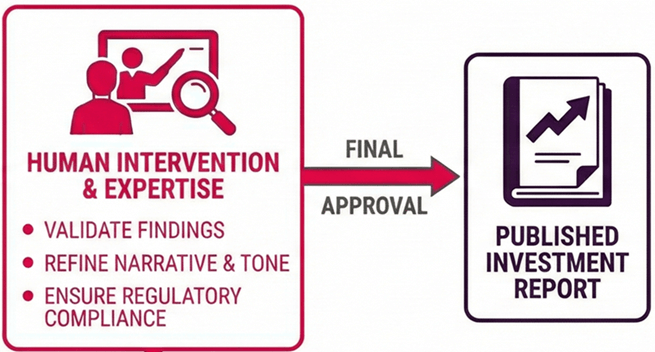
Humans also play a critical role in maintaining ethical and regulatory compliance. AI systems may inadvertently introduce biased language, misinterpret forward-looking statements, or mishandle sensitive data. Human oversight is necessary in the review of disclosures, validation of sources, and protection of confidential information, ultimately ensuring that published materials meet legal and compliance requirements. In conclusion, while AI improves efficiency and speed, human expertise safeguards quality, accountability, and trust in investment research publications, and as in every other case of mind+machine™, we must aspire to reach a happy medium between the two.
Talk to One of Our Experts
Get in touch today to find out about how Evalueserve can help you improve your processes, making you better, faster and more efficient.