TL;DR
In 2026, commercial excellence means aligning sales, marketing, pricing, and procurement into a single, intelligence-led operating model.
Global businesses that integrate data, AI, and cross-functional decision-making are better positioned to grow profitably, respond faster to volatility, and protect margins in an increasingly complex environment.
1. Why Commercial Excellence Is a Strategic Imperative in 2026
By 2026, global businesses are operating in a world defined by persistent uncertainty rather than temporary disruption. Input-cost volatility, fragmented customer journeys, regulatory pressure, and ongoing supply risk have become structural realities, not short-term shocks.
In this environment, traditional approaches to growth no longer work.
Optimizing sales, marketing, pricing, or procurement in isolation creates friction, delays decisions, and often erodes value. Commercial excellence addresses this challenge by bringing these functions together under a shared, intelligence-driven operating model.
What has changed in 2026 is not the ambition, but the urgency.
- Margins are under continuous pressure, making the link between pricing and procurement more critical than ever.
- Customer expectations are evolving faster, requiring marketing and sales to act on real-time insights rather than lagging indicators.
- Decision cycles must shorten, as annual planning and manual analysis can’t keep pace with market shifts.
Commercial excellence enables organizations to respond to these pressures by embedding analytics and AI directly into commercial and sourcing decisions, ensuring that growth and cost strategies reinforce each other rather than compete.
This is why leading organizations now view commercial excellence as a core business capability, not a transformation initiative.
2. How Different Industries Define Commercial Excellence
Commercial excellence looks different across global industries, but the goal is the same: smarter, faster, more connected decision-making.
Manufacturing
Manufacturers face volatile input costs, supply chain disruptions, and pressure to improve margin reliability.
Commercial excellence here means:
- Tight linking of procurement intelligence with pricing
- Customer and account segmentation based on profitability
- AI-driven forecasting and demand planning
- Identifying high-value opportunities faster
Case in point: A chemicals company achieved 70% faster cost modeling through agentic AI, giving procurement and pricing teams the insights they needed to negotiate better and adjust prices more frequently.
Case study: 70% Faster Cost Models Using Agentic AI
CPG
Consumer packaged goods companies grapple with channel shifts, fragmentation, and rising trade spend.
For them, commercial excellence is:
- Real-time insights into consumer behavior
- Unified pricing, promotions, and retailer strategy
- Cross-functional planning between procurement and marketing
- Faster innovation cycles using integrated demand insights
Better visibility into costs, competitors, and consumer priorities enables CPG leaders to shift from reactive firefighting to proactive growth.
Retail
Retailers face margin pressure, supply shocks, and the need to shift inventory quickly across channels.
Commercial excellence in retail means:
- Connecting procurement, merchandising, pricing, and marketing
- Making faster pricing decisions based on elasticity, competition, and cost
- Automating lead routing in B2B retail environments
- Driving omnichannel consistency
Example: A global B2B business unlocked $180K in incremental revenue by automating lead qualification, accelerating how marketing and sales respond to demand.
Case study: Automated Lead Qualification Unlocks $180K Revenue
Pharma
Pharmaceutical companies must navigate regulatory complexity, intense competition, and huge commercialization costs.
Commercial excellence in pharma includes:
- Aligning sales, medical, marketing, and market access functions
- Accelerating opportunity evaluation
- Prioritizing indications and therapy areas using evidence and cost data
- Incorporating procurement intelligence into supply strategy
Case in point: A pharma giant reduced opportunity evaluation time by 27%, enabling faster, more confident commercialization decisions.
Case study: Pharma Giant Cuts Opportunity Evaluation Time by 27%
3. What Commercial Excellence Actually Means in 2026
By 2026, commercial excellence is no longer about incremental optimization or isolated transformation initiatives. It has become a core operating capability for global organizations navigating persistent volatility, cost pressure, and accelerating customer expectations.
In practical terms, commercial excellence in 2026 means treating sales, marketing, pricing, and procurement as one interconnected value system, governed by shared data, shared objectives, and faster decision cycles.
Three forces are reshaping what commercial excellence looks like in 2026:
1. Revenue and cost decisions are fully intertwined
In 2026, organizations can no longer afford to separate “growth conversations” from “cost conversations.”
Pricing strategies must reflect real-time procurement and input-cost dynamics. Marketing investments must align with supply availability and margin priorities.
Commercial excellence creates a single, coordinated view of value, where demand generation, pricing, and sourcing decisions reinforce - rather than contradict - one another.
2. Speed and adaptability are structural advantages
Annual planning cycles and static dashboards are insufficient in a world of continuous disruption.
Commercial excellence in 2026 emphasizes:
- Shorter decision loops
- Scenario-based planning
- AI-supported recommendations embedded in daily workflows
Organizations that operationalize this speed consistently outperform peers who still rely on sequential, manual decision-making.
3. Complexity requires intelligence, not headcount
As global operations expand across regions, channels, and partners, complexity rises sharply. Commercial excellence provides the analytical backbone to manage this complexity, identifying where value is created, where it erodes, and how to act at scale.
This is why Evalueserve frames commercial excellence as an enterprise operating model, not a point solution. Learn more about our approach on the Commercial Excellence solutions page.
For a deeper view on how AI enables this shift, see: AI-Enabled Commercial Excellence: Taking a Holistic Approach to Transformation
4. The Five Pillars of Commercial Excellence, Applied Cross-Industry
While the fundamentals of commercial excellence remain consistent, how organizations operationalize them in 2026 has evolved. The focus has shifted from static frameworks to adaptive, intelligence-led execution that connects revenue and cost decisions in real time.
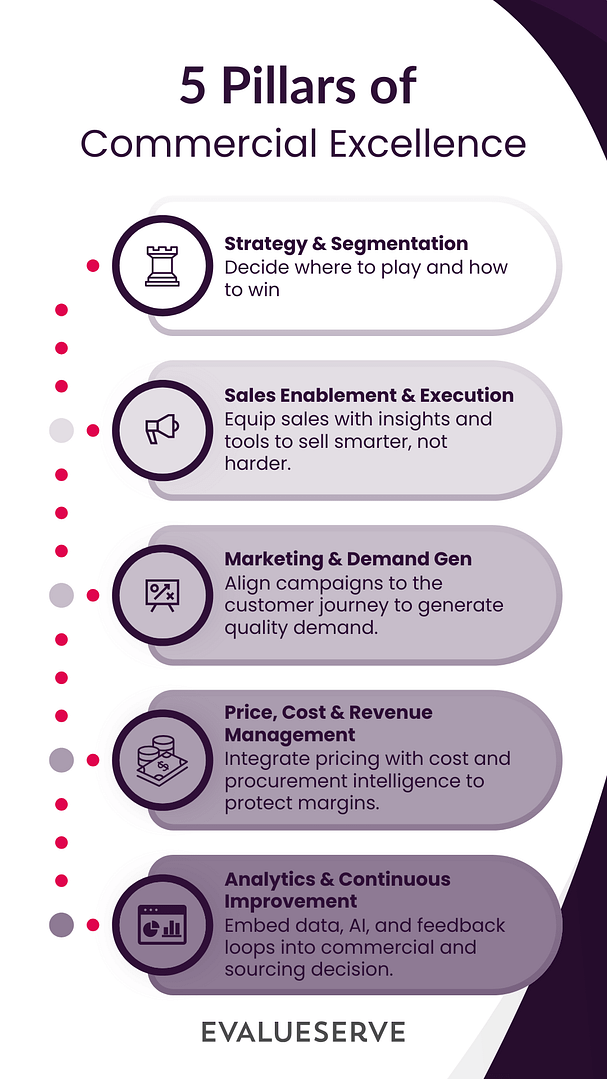
In 2026, organizations that treat these pillars as interdependent capabilities - rather than standalone initiatives - are best positioned to achieve scalable, resilient commercial excellence.
Learn how Evalueserve operationalizes these pillars through its Commercial Excellence solutions and AI-enabled commercial excellence framework.
5. Who Is Responsible for Commercial Excellence?
As commercial excellence matures in 2026, the question of ownership becomes more pressing:
Who is accountable for making it work day to day?
The answer is still cross-functional, but with clearer governance.
Commercial excellence is typically:
- Sponsored by the CCO, CRO, or equivalent commercial leader
- Co-owned by leaders in sales, marketing, pricing, and procurement
- Enabled by analytics, AI, and digital transformation teams
What differentiates successful organizations in 2026 is not where commercial excellence “sits,” but how it is governed.
In practice, this includes:
- Shared KPIs balancing growth, margin, and resilience
- Regular cross-functional decision forums
- Clear ownership of insights → actions → outcomes
- Technology platforms that ensure transparency and speed
Evalueserve supports this model through structured diagnostics, roadmaps, and AI-enabled execution frameworks.
6. How Global Enterprises Can Begin Their Journey
Here’s a practical, industry-agnostic starting point:
1. Assess your current maturity: Map how well sales, marketing, pricing, and procurement collaborate.
2. Identify high-value use cases:
- faster opportunity evaluation (pharma)
- better cost modeling (manufacturing)
- real-time pricing (retail/CPG)
- automated qualification (B2B retail/manufacturing)
3. Design cross-functional workflows: Don’t just deploy AI — redesign how teams make decisions.
4. Pilot, scale, and institutionalize: Prove value quickly; roll out globally.
5. Embed insights into daily operations: Build dashboards, AI copilots, and automated workflows.
Conclusion
Commercial excellence isn’t a single initiative, it’s the operating system for profitable, resilient growth across industries. When sales, marketing, pricing, and procurement act as one intelligent ecosystem powered by analytics and AI, companies respond faster, grow smarter, and outperform competitors.
If your organization is ready to elevate commercial performance:
Talk to One of Our Experts
Get in touch today to find out about how Evalueserve can help you improve your processes, making you better, faster and more efficient.