
eBook
Reference Data Management Explained: Benefits, Challenges, and Best Practices
Introduction to Reference Data Management
What is Reference Data Management?
Reference Data Management (RDM) involves the maintenance and governance of static data used in financial transactions, such as security identifiers and legal entity identifiers. Effective RDM ensures data accuracy, consistency, and compliance, which are vital for smooth trading operations.

Importance of Reference Data Management
Why RDM Matters
RDM is crucial for the seamless operation of financial markets. It ensures that all static data, such as security terms and conditions, maturity dates, and customer data, are accurate and up to date. This helps in reducing errors, improving compliance, and enhancing operational efficiency.

Key Components of Reference Data Management
Components of RDM
Effective RDM includes several key components:

Understanding these components is essential for robust RDM practices.
Challenges in Reference Data Management
RDM Challenges
Managing reference data comes with its own set of challenges, including:
- Ensuring data accuracy and consistency
- Handling large volumes of data
- Adhering to regulatory requirements
- Integrating data from multiple sources
Despite these challenges, an effective RDM is critical for maintaining market integrity and operational efficiency.
Benefits of Effective Reference Data Management
Benefits of RDM
Effective RDM offers numerous benefits, such as:
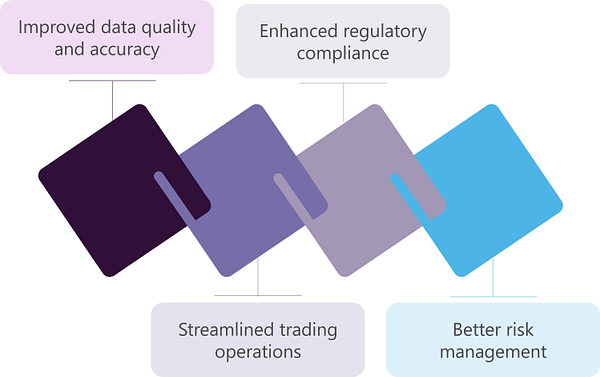
These benefits contribute to more efficient and reliable financial operations.
How Evalueserve Can Help with Reference Data Management
Evalueserve's Expertise in RDM
At Evalueserve, we offer comprehensive Reference Data Management services to streamline your operations. Our solutions include:
- Define Security Types and Categories: Identify and define the broad categories of securities (e.g., equities, fixed income, derivatives, private equity, etc.).
- Create a New Security Record Security Master: Start by adding the security in the Security Master. This is the centralized repository where all security data will be stored
- Enter Security Pricing Information Market Price Source: Define the pricing sources for the security. You can link to external market price providers or set up custom price sources
- Define Currency and Exchange Information Currency: Specify the currency in which the security is denominated (e.g., USD, EUR, GBP). This is important for conversion and reporting purposes
- Set Up Corporate Actions and Event Processing Corporate Action Settings: If the security is subject to corporate actions (e.g., dividends, stock splits, bond calls, etc.), configure the platform to handle these actions automatically
- Define Settlement Details Settlement Instructions (SSI): Define the Settlement Instructions for the security, specifying details about how the security should be settled (e.g., Delivery vs. Payment [DvP], Free of Payment [FoP]).
- Define Tax Information Tax Categories: For income-producing securities, define tax categories (e.g., interest income, dividend income, capital gains) based on jurisdiction
- Configure Accounting Treatment Accrual Method: For fixed-income and income-generating securities, define the accounting treatment (accrual, cash basis) and the methods for calculating interest and amortization.
- Link Security to Portfolio or Fund Portfolio Allocation: After creating the security, assign it to a specific portfolio or fund in Geneva. This ensures the security is part of the appropriate investment strategy.
- Define Cash and Margin Requirements (for Derivatives/Leverage) Margin requirements: for securities that involve margin (e.g., derivatives), define the margin requirements for each security, including the initial and maintenance margin
- Reconciliation Setup Reconciliation Rules: Define the reconciliation rules to ensure that positions and cash balances for each security match between internal records, custodians, and external parties (e.g., counterparties, brokers).
- Testing and Validation Back-testing: Before fully implementing the new security in a live environment, conduct back-testing and validation procedures to ensure the setup is correct
- Ongoing Maintenance and Updates Regular Updates: Ensure that the security information is updated periodically. This may include price updates, corporate action changes, or adjustments to settlement details.
- Security Reporting Generate Reports: Create and review reports that include the security's position, pricing, performance, and accounting details.
Partner with Evalueserve to leverage our expertise and ensure seamless Reference Data Management.
